Jack and Pack in Bendigo
The cheapest way to get a floor back towards level — when the house qualifies for it.
Jack and pack costs a fraction of a restump. It is also the wrong answer more often than it’s the right one, and packing a house that needed restumping is money spent twice.
So the useful question isn’t whether jack and pack is cheaper. It’s whether your house is a candidate.
What jack and pack actually involves
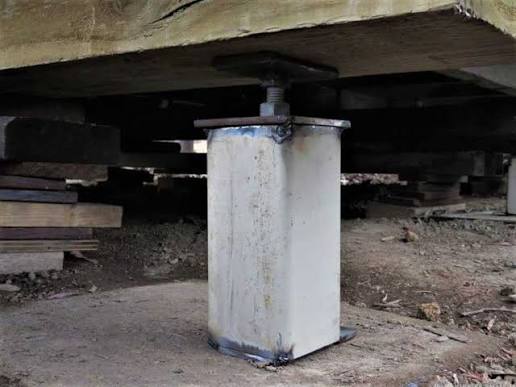
The house is lifted in controlled stages from underneath, and packing is inserted between the top of each existing stump and the bearer sitting on it. The floor comes back towards level. The stumps stay exactly where they are.
That last point is the whole method. Nothing is dug out, nothing is replaced, no new stumps go in the ground. The existing stumps keep carrying the house — they just carry it slightly higher than they were.
Which is why it’s cheap, and why the condition of those stumps decides everything.
If the stumps are sound and the house has simply settled, packing is a legitimate structural repair that has been used on Victorian housing for a very long time. If the stumps have rotted or sunk, packing raises the floor while leaving the actual fault in the ground — and the floor drops again.
Where the stumps have failed, the work is restumping. Where the ground has failed, it’s underpinning. All four options and what each costs: house levelling in Bendigo.
When jack and pack is the right call
Four conditions generally need to be met. Not one or two — all of them.
- The stumps are structurally sound along their full length. No rot at ground line, no splitting, no crushing at the top, no ant or borer damage. This is checked by getting under the house and inspecting them, not inferred from the age of the building.
- The stumps haven’t sunk. A sound stump that has pushed down into soft ground is a ground problem wearing a stump costume. Packing it lifts the house temporarily and the stump keeps going down.
- The ground underneath is stable. If reactive clay or settlement over old workings is driving the movement, packing treats the symptom. The house will need it again, and again.
- The bearers and joists are sound. Jacking a house with rotted bearers or borer-eaten joists can crack or split the timber it’s lifting from. Sometimes timber repairs have to happen before any lifting is possible.
Meet all four and jack and pack is the sensible, economical answer, and there’s no good reason to spend restumping money. Miss one and it’s a temporary fix sold as a permanent one.
When packing is the wrong answer
Being clear about this is more useful than selling the cheap option to everyone who asks for it.
Original timber stumps at end of life. On a gold-era Bendigo cottage the stumps may have been in the ground for 90 to 160 years. Red gum lasts remarkably well, but not indefinitely, and the failure point is almost always at ground line where moisture and oxygen meet. A stump that looks fine from the middle can be gone at the base.
Mixed stump ages across one house. Very common here. Someone replaced the stumps on the worst side in the 1970s with concrete and left the 1880s timber on the other. The two halves settle at different rates permanently. Packing levels it today and it’s out again in a few seasons, because the underlying cause is that the house is sitting on two different structures.
Ground movement rather than stump settlement. Reactive clay above, historic workings below — Bendigo has both, and neither is fixed by packing. Why Bendigo ground moves →
Slab-on-ground homes. There is nothing to jack and nothing to pack. Houses in Maiden Gully, Strathfieldsaye, Junortoun, Epsom and the other newer estates sit on a slab, and the only structural option is underpinning or slab repair.
A house that’s already been packed several times. Stacked packing that has been added to repeatedly is usually a sign the real fault was never addressed. More packing on top of old packing is not a repair.
What packing should look like — and what to look for underneath
Packing material varies. Seasoned hardwood packers are the traditional and still the most common choice in Victoria. Steel plate and pre-cast concrete pads are also used, particularly where clearance is tight or loads are higher.
What matters more than the material is the workmanship, and it’s visible if you know what you’re looking at:
- Packing should be fixed in place, not loose. Loose wedges driven in and left can work their way out with seasonal movement and vibration.
- Full bearing across the stump top. A packer sitting on part of the stump face concentrates load on that part.
- Minimal stacking. One or two packers is normal. A tower of six is not packing, it’s a warning that the stump has dropped a long way and should have been replaced.
- No bricks, no half-bricks, no random offcuts. These turn up under Bendigo houses constantly. Brick crushes and spalls under point load.
- Untreated softwood offcuts don’t belong under a house. They rot, and they’re food for borers.
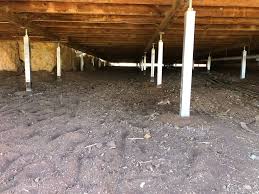
If you’ve got access to your own subfloor, a torch and a look is genuinely informative. Stacked timber, bricks, or packers that fall out when touched all tell you what the last person did and how well.