
Restumping, Reblocking and Underpinning: What's the Difference?
The short answer, because it’s the reason most people land here:
- Restumping and reblocking are the same job. Two words, one piece of work. Reblocking is the older Victorian term.
- Underpinning is a different job entirely. It deals with footings and the ground, not the posts a floor sits on.
- Relevelling and house levelling describe an outcome, not a method. Any of the above can achieve it.
- Jack and pack is a specific method — and the cheapest one.
That’s the whole answer. The rest of this page explains why the distinction matters when you’re holding two quotes that appear to be for different things and aren’t — or appear to be for the same thing and aren’t.
Restumping and reblocking: same job, two words
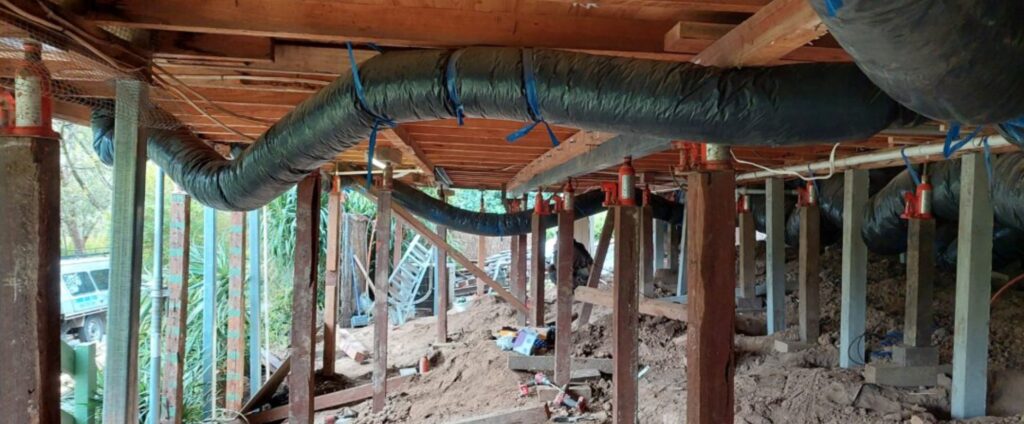
A house with a suspended timber floor sits on a grid of posts. Floorboards on joists, joists on bearers, bearers on posts, posts in the ground. Replacing those posts is the job.
In Victoria, the job is commonly known by two names: restumping and reblocking. Today, restumping is the term used most often, while reblocking is the older Victorian term. The name reblocking is generally understood to have originated from the timber or concrete blocks that traditionally supported many older homes before stumps became the more common industry term. Today, both terms are widely used interchangeably to describe the same process of replacing a home’s foundation supports.
Some operators use one word, some the other, some both. There is no technical distinction. If you get one quote for restumping and one for reblocking, you are looking at quotes for the same work and you can compare them directly.
Worth knowing: “reblocking” is distinctively Victorian. It has real search volume here and very little interstate, which is why sites run from outside Victoria targeting Victorian towns tend to ignore the word entirely. If a company servicing Bendigo never uses it, that’s a small signal about where they’re actually based.

Restumping vs underpinning: genuinely different jobs
This is the distinction that costs people money when they get it wrong, because the price gap runs into tens of thousands.
| Restumping / reblocking | Underpinning | |
|---|---|---|
| What’s replaced | The stumps — the posts holding up a suspended floor | Nothing is replaced. The existing footing is extended or supported deeper |
| What’s wrong | The posts have rotted, split, sunk or been eaten out | The ground won’t carry the load evenly |
| House types | Timber-floored houses on stumps | Brick on strip footings, and slab-on-ground homes |
| Possible on a slab home? | No — there are no stumps | Yes — it’s the only structural option |
| Typical cost | Around $280 – $550 per stump; $12,000 – $30,000 for a full house | Around $1,200 – $2,500 per pier; $15,000 – $40,000+ whole house |
| Engineering | Sometimes | Effectively always — pier design comes from an engineer |
The plain version: restumping fixes what’s standing on the ground. Underpinning fixes the ground.
Which means a house can need both, one, or neither — and it’s entirely possible for the stumps to be perfectly sound while the house is still moving. Underpinning in Bendigo →
Levelling, relevelling and jack and pack: where they fit
Here’s where most of the confusion actually comes from. Some of these words describe a job, and some describe a result. They get used interchangeably and they shouldn’t be.
House levelling and relevelling are results. The floor isn’t level and the goal is to bring it back. That’s the outcome, not the method. Restumping can achieve it. Jack and pack can achieve it. Underpinning can achieve it. Which one applies depends on why the floor went out of level.
So a quote for “relevelling” hasn’t told you what work is being done. It’s a legitimate term, but it needs a method attached to it before it means anything.
Jack and pack is a method, and a specific one. The house is jacked up and packing is inserted between the existing stump tops and the bearers. Nothing is dug out, nothing is replaced. It only works where the stumps are already sound and the ground is stable — but where those conditions hold, it costs a fraction of the alternatives.
It’s also the one most likely to go unmentioned, because it’s a small job with limited margin. When jack and pack works, and when it doesn’t →
Every term you'll hear, in one place
| Term | Job or outcome | What it means |
|---|---|---|
| Restumping | Job | Replacing the stumps under a suspended timber floor |
| Reblocking | Job | The same job. Older Victorian term |
| Underpinning | Job | Extending or supporting footings down to ground that will carry the load |
| Jack and pack | Job | Lifting the house and packing on top of existing sound stumps |
| House levelling | Outcome | Getting the floors level, by whichever method suits |
| Relevelling | Outcome | Same as above. Usually implies it was levelled before |
| Subfloor repairs | Job | Bearers, joists, ventilation and damp — the layer between stumps and floorboards |
| Stumps / blocks | — | The posts. Timber, concrete or galvanised steel |
| Bearers | — | Horizontal timbers sitting on the stumps |
| Joists | — | Timbers sitting across the bearers, carrying the floorboards |
| Piers | — | What underpinning installs. Not the same as stumps |
| Screw piles | — | Steel piles screwed down to load-bearing strata. An underpinning method |
| Resin injection | — | Structural resin injected to consolidate soil. An underpinning method |
| Mass concrete underpinning | — | Excavating beneath the footing in stages and filling with concrete |
| Site classification | — | How reactive the ground is, under AS 2870. A to E, plus P for problem sites |
| Class P | — | A problem site. Standard footing design doesn’t apply; an engineer must design specifically |
Why this costs people money
Three specific ways the terminology trips people up.
1. Comparing quotes that aren’t comparable. If one quote says restumping and another says underpinning, those are quotes for different work — and at least one of the two has diagnosed your house differently. The gap between them isn’t a price difference to negotiate. It’s a disagreement about what’s wrong, and you need to resolve that before you compare dollars.
2. Assuming reblocking is cheaper. It isn’t a lesser version of restumping. It’s the same job under an older name. If one quote is materially cheaper, the reason is scope, stump count, materials or exclusions — not the word on the letterhead.
3. Accepting “relevelling” without a method. A relevelling quote could mean jack and pack at a few thousand dollars, or a full restump at twenty-five. Both are honestly described as relevelling. Ask which method, and ask why that one.
The useful question in every case isn’t “what’s this called”. It’s “what do you think is causing the movement, and how did you establish that”. Terminology follows from the diagnosis. The nine questions to ask every quote →
Which one applies to your house?
A rough path. Not a substitute for someone measuring floor levels, but enough to know which conversation you’re having.
- Is it a slab-on-ground house? If yes, restumping, reblocking and jack and pack are all impossible — there are no stumps. The conversation is underpinning or slab repair. Most Bendigo housing built from roughly the 1980s onward falls here: Maiden Gully, Epsom, Strathdale, Junortoun, Strathfieldsaye, Huntly, Marong.
- Does it have a timber floor on stumps? All options are live. Gold-era and post-war Bendigo housing — Long Gully, Golden Square, Quarry Hill, Ironbark, Eaglehawk, Flora Hill, Kennington.
- Are the stumps sound? Only findable by getting under the house. Sound stumps plus a settled house points to jack and pack. Failed stumps points to restumping.
- Is the movement seasonal or one-way? Cracks that open in summer and close after a wet winter suggest reactive clay, and the first fix is usually drainage rather than structural work. Movement that only ever goes one direction suggests stumps or ground.
- Are the stumps sound and the house still moving? That’s a ground problem. Underpinning.
In Bendigo there’s a fourth possibility that doesn’t exist in most cities: subsidence over historic mine workings. Reactive clay above, old workings below, and both produce the same sloping floors. Why Bendigo ground moves →
All four methods compared with costs: house levelling in Bendigo.